Friday, 31 August 2018

Forts And Foreshores: The Estuary


The defences of the Thames Estuary, dating from Tudor times up to the Second World War, occupied much of my time a couple of years ago and led to four articles. Although I supposed that some of my field trips would be repeated as return visits*, I never expected to write a fifth entry in my Forts And Foreshores series... not until an opportunity arose for one further exploration. This one, however, would be a little different. Instead of seeking out military remains on the foreshores of the Thames, Team Vulpine and I would go out on the water and explore the The Estuary itself.

Our day of discovery began on a late August Day in Southend On Sea. The weather was sunny with light cloud, a very gentle breeze and only a 1% chance of precipitation, so -  with much optimism - I set off with my offspring to casually stroll the length of the town's most famous landmark, the Longest Pier In The World.

Southend Pier

The original Pier was a wooden structure, opened in 1830 and extending 180m. However, the Thames at low tide recedes for over a mile, so in order for the Pier to provide docking facilities, it was gradually extended until, by 1848, it was 2,100m and the longest Pier in Europe. The growing popularity of the resort led to the wooden pier eventually wearing out, and it was replaced in 1887-9 by the iron Pier that stands today. It was designed by James Brunlees and was extended yet again in the 1920's. Today the Pier is 2,158 metres long and a Grade II listed building.

Like many of the crumbling Victorian fortifications that dot the Thames foreshore, the Pier was put to military use in the Second World War. It was closed to the public in September 1939 and named HMS Leigh, with the surrounding area given the designation of HMS Westcliff. It was Naval Control for the Thames Estuary and a mustering point for convoys, of which 3,367 departed from the area over the course of the conflict. It re-opened to the public upon cessation of hostilities in 1945.

Other changes occurred in the Estuary during the War, new military structures were provided, and we would be getting up close and personal with some of those structures later in the day...

RV Jacob Marley


The boat upon which we were destined to travel was the RV Jacob Marley, operated by Jetstream Tours and based at Rochester. That ancient Kent town can be reached by crossing the Estuary and heading south along the River Medway. The confluence of the two rivers can clearly be seen from the Pierhead, and was the major subject of my last article about the area. Rochester has many associations with Charles Dickens, hence the reason the boat is named after Ebenezer Scrooge's deceased partner.


...named after a Dickens character

We sat within the body of the vessel and it departed the Pierhead at 1145, heading east toward the limits of the Estuary. We did not remain inside for very long. The day was bright and clear, the surface of the water almost glacial in its calmness. The heads of curious seals bobbed occasionally ahead of us, and great cargo ships outran us as they ploughed through the Thames shipping channel on their way to the North Sea.

Heading east...

...and heading west. Note the calmness of the water.

Before long, we encounter our first crumbling relic of the War, its back broken on a sandbank, looking like a gargantuan beached whale. This is a Phoenix Cassion, one of several types of structure known as Mulberry Harbours. Its overall length is 61m, it is 9.75m wide, 6m high, weighs 2,500 tons, and it forms an unmissable landmark (seamark?) a mile and a half from the beaches of Thorpe Bay.

Mulberry Harbour
It was constructed in 1944 as part of the preparations for the Allied invasion of Europe. Planners knew that not only would they have to capture beachheads, but maintain the traffic of personnel and materials. The Channel ports were unreliable as they would be heavily fortified by the enemy, so these mobile  pre-fab 'harbours' were created, built in sections and towed across the Channel for assembly close to the invasion points.

This example was being towed from Immingham (on the Humber) to Southsea (on the South Coast) in June 1944 when it sprang a leak. The pilots signalled the Naval Control at Southend Pier (HMS Leigh), and it was towed to its present position and allowed to flounder on the West Knock sandbank.

Our vessel continues to move farther into the Estuary. We begin to spot examples of our smallest cetacean, the Harbour Porpoise, as they duck and dive through the calm waters around us. And on the horizon, more structures are looming...

A collection of structures...

...collectively known as...

...Red Sands Fort
There are about 50 people on the vessel, and now many of them cluster around the prow with cameras and filming equipment at the ready, as we draw ever closer and the silent sentinels begin to tower over us.

Red Sands Fort is one of a specific type of fort designed by the engineer Guy Anson Maunsell (1884-1961) to defend the Mersey and Thames Estuaries from enemy aircraft dropping magnetic mines. Three of these Forts - Red Sands, Shivering Sands and Nore, were constructed in the Thames Estuary and were controlled by the Army, while the Navy had control of four other forts further away from the coast. They were erected in 1943, could hold up to 265 soldiers, and, during their two years of active service, they shot down 22 enemy planes, 30 flying bombs and even managed to destroy a U-boat.

RV Jacob Marley circles the haunting structure. Gulls watch us disinterestedly from their roosts on lofty girders, while alert peregrines fly between the rusting towers, their falcon screams punctuating the hushed chatter of the human intruders. Cameras click and whirr, punctuating the daunting, historic atmosphere with the music of modern technology.


When the war drew to a close, the Forts were maintained until 1956, when their artillery was removed and they were abandoned to the elements. However, the Nore Fort had already proved to be a hazard to maritime traffic, due to its close proximity to shipping lanes. In 1953, a Swedish vessel called Baalbeck collided with one of its towers and knocked it over. Four civilians were killed and six of the Fort's occupants required hospital treatment on the mainland. The following year, there was a further collision with the vessel Mairoula, and the rest of the Fort was dismantled in 1959-60. Part of its concrete base can be seen stranded on the foreshore several miles west, next to the derelict Cliffe Fort and the shipwreck Hans Egede**. Another collision in 1963 took down one of the towers at the Shivering Sands Fort, which can be seen on the eastern horizon from our current position. As a result of these vicissitudes, the Red Sands Fort is the only one of the three Army forts that remains intact.


In 1964, a ship moored outside UK territorial waters began broadcasting as Radio Caroline. Its success prompted other broadcasters to descend upon the area, and they used the abandoned Forts as their studios. The pop star David 'Screaming Lord' Sutch set up Radio Sutch (later Radio City) at the Shivering Sands, while Radio 390 established itself at Red Sands. Two of the Navy forts beyond the Estuary also hosted pirate radio stations, but they were all abandoned by 1967 following a series of prosecutions.


Today, the Fort has come under the auspices of Project Redsand, a charity which wishes to restore the structure as a museum to the ingenuity of Guy Maunsell. The site has been surveyed and access to two of the towers restored. The renovations will take place on a tower-by-tower basis as funding becomes available. It is expected to take years.


After a final circling of the impressive monument, our vessel turns and moves west, deawing closer to the Kentish coast, staying near the Medway shipping lane that leads into the confluence. It seemed sad to leave these imposing towers behind, but at least the peregrines could stop stressing.

With Sheerness to our port side, we pass the sandbank known as the Nore. Somewhere in this area stood the demolished Nore Fort, but the sandbank itself has an older history than the conflicts of the 20th Century. It was, in the days of tall ships, a major anchorage for the English fleet, and in 1797 - in tandem with another major anchorage at Spithead in the Solent - was the scene of a Mutiny.

Spithead occurred first, and was more in the nature of a strike against poor pay and conditions. The Admiralty, alarmed at these events at a time when we were dealing with the Napoleonic threat, negotiated better pay and conditions as well as pardons for all involved. The mariners at the Nore, inspired by these capitulations, launched their own action but also included political demands, such as the dissolutin of Parliament and an immediate cessation of hostilities with France. The Admiralty could not countenance these demands, and offered only pardons. They also blockaded London with 50 ships to prevent the mutineers moving toward the City, only for the mutineers to counter this action by preventing merchant ships from slipping past the Nore and reaching the capital. However, lack of victuals eventually led to the mutiny coming apart and most ships deserted the cause. The Admiralty's reprisals were harsher than at Spithead. 29 men were hanged, including the ringleader Richard Parker, 29 were imprisoned, 9 were flogged and more were transported.

Parker demanding terms at the Nore

Our vessel, full of thoroughly contented people, continues toward the confluence. We can see the Grain Sea Fort, a Victorian structure with the amusing address of No.1, Thames, and the traffic at the Sheerness docks... and now we approach one of the most infamous relics in the Estuary.

DANGER!!!

The approach is slow and rather suspenseful, since we are nearing a wide ring of warning buoys, their messages mercifully stopping short of promising instant doom if we venture beyond. In the centre of this forbidding circle, three masts protrude from the water. We have arrived at the infamous wreck of the SS Richard Montgomery.

She was a type of cargo ship of the US Navy that were classed as Liberty ships, and was named after a hero of the Revolutionary War. Built in 1943, she was waiting at the Great Nore Anchorage to join a convoy to Cherbourg when she ran aground on the sandbank and subsequently broke her back. This was on August 1944. Salvage was carried out until September, when efforts were called off.


Unfortunately, she still had 1,500 tons of explosive munitions on board. It has been estimated that if all these munitions would detonate, debris would be thrown 3,000m into the air and a 5m wave would hit the shores of Sheerness and Southend. There is no consensus on the condition of the sunken munitions.

Hence the need for an exclusion zone.

In better days

Oops...

The scene in August 2018

Now our vessel turns away from this potential time-bomb, and begins to cross the Estuary, back toward our docking place at Southend Pier. The pilot, through his tannoy, regales us with the story of another wreck, an older one, also in the water below us, and only rediscovered a few years ago... The London. Built in 1656, she floundered here in 1665, an event noted by the Secretary to the Navy... yes, my old mate Samuel Pepys:

"This morning is brought me to the office the sad newes of The London, in which Sir J Lawson's men were all bringing her from Chatham to the Hope, and thence he was to go to sea in her; but a little a'this side the buoy of the Nower, she suddenly blew up. About 24 and a woman that were in the round-house and coach were saved; the rest, being above 300, drowned: the ship breaking all in pieces, with 80 pieces of brass ordnance. She lies sunk, with her round-house above water. Sir J Lawson hath a great loss in this of so many good chosen men, and many relations among them. I went to the 'Change, where the news taken very much to heart."

The London as it looked in 1656

The ship was rediscovered in 2005, leading the Port of London to shift some buoys about in order to move the shipping lane to protect it from further peril. A charity, the London Shipwreck Trust, now organises groups of divers to chart and investigate the wreck. In 2015 a gun-carriage was recovered in very good condition.


So a ship that everyone worries about blowing up lies only a short distance from a ship that did blow up. We have time to consider history's little ironies as our own boat crosses the Estuary. Today we revisited our old Forts And Foreshores quests, saw terns and turnstones, porpoises and peregrines, seals and sentinels. The calm waters, the deceptively glassy surface of the Thames as its mighty strength rushes into the North Sea, conceals the centuries of turmoil that lie on the sea bed... the hulk of The London, the humpback of the Mulberry Harbour, the submerged menace of the Montgomery, the hundred vessels that were sunk by mines here before the guns of the Maunsell Towers brought planes screaming down to destruction in the roiling maritime.

The Estuary is a world apart, a place of violence and serenity, of memory and anticipation, of hidden depths and shallow features. Across all that time, the waters have rolled on, occasionally giving up their secrets, and continuing to shield countless more...


*It has happened twice. The Forts at Cliffe and Coalhouse have been revisited since my original articles.

**Covered in the original F&F article, links below.


Forts And Foreshores
Forts And Foreshores: The Return
Forts And Foreshores: The Other Side
Forts And Foreshores: The Confluence

Wednesday, 25 July 2018

The Longest Day

On 21st June, the Summer Solstice, I was involved in an unexpected 'incident', while exploring a historic site in Surrey.

I had dropped off my Eldest at his friend's flat in Reading, as they were venturing to Exmoor for a camping trip. I decided to dawdle on my way home, in order to explore a historic site. What happened next, I will relate by repeating the subsequent text messages that were exchanged between me and my Eldest, and between me and a woman who I will call Susan.

Warning in advance: This is darker and more upsetting than my usual posts. That day haunts me still. I'm writing this, hopefully, as a form of catharsis. I have provided, in brackets, the times of the text messages.


Me (1919): Well, my afternoon was one of mixed fortunes. I explored and photographed enough of Runnymede for a blog post, and discovered a Harvester in Old Windsor. I also ended up covered in blood and hugging a hysterical woman. This year has had far too much trauma.

Eldest (1938): What happened?

Me (1953): After lunch I walked along the bank of the Thames, following a National Trust path. After half a mile, the path crosses the road and passes through a gate in the hedgerow, to enter the meadows where Magna Carta was signed. I was waiting to cross when a small dog squeezed under the gate, sprinted into the road and went straight under the wheels of a passing car (which didn't stop). It had run away from its owner, a young woman called Susan, who lives on a local riverboat and comes from Cornwall. I scooped it up and laid it on the verge. It was alive but obviously dying. I phoned the number on its collar but the dog, Lily, died in my arms just before Susan arrived. You can imagine the next few minutes. Once Susan was calmer, I carried the dog back to the houseboat, then returned to my car to wash my hands and arms in the river and to change my very bloody shirt. Guess it was good that I brought my backpack after all. Continued my quest, but it felt a bit robotic after that. Guess I was in shock. Burst into tears sitting alone at the Magna Carta Memorial.

Eldest: That's horrible...

Me: One of the few walks I'm glad you missed

Eldest: Devastating... I don't really know what to say that could console

Me: Just finished dinner at the Harvester in Old Windsor. Heading home now. Pets need feeding x

Eldest: I'm sorry it happened. For both the woman and you.

Me: Be out of contact til I get home. I'll let you know when I'm there.

Eldest: Take care

...


Me (2130): Home. Passed three accidents on M25. At the first, paramedics were giving someone CPR on the roadside. This has been my strangest Solstice ever.

Eldest: Jfc. What a day


...


Susan (1827): Hello, I think this is the number of the gentleman who tried to help Lily today? I just wanted to say thank you so much for trying to help her and for carrying her home for me. I really appreciate that you were there for her and that you tried to help. Susan x

Me (1904): Thank you Susan. I'm afraid my stoicism didn't last long after I left you. I buried my Nan last week, and her middle name was Lily. I found myself in a bit of a state. Delayed shock and repressed grief at the same time. Now I'm calmer, I believe it was good that I was there, that I could comfort your little dog in her last moments, that she knew she was not alone. I hope that gives you some comfort at this sad time. Thanks again x

Susan (1916): Oh no, I'm so sorry to hear about your Nan and then to have to experience this so soon afterwards. But I agree, I'm really glad that you were there for her before she went, she was  alovely affectionate dog who loved to be with people so I'm sure she appreciated that someone was there with her. And I'm deeply grateful that you were there to help, I don't know what I would have done if I'd had to find her by myself and not known exactly how it went at the end. It definitely gives me some comfort to know that a compassionate person was there with her at the end and it helped me a lot, having someone with me to help take her home. Thank you so much, Susan x


Thus ended the Longest Day.


Tuesday, 6 February 2018

Imbolc Sky

An Imbolc sky, a relentless mass of swirling grey
Hangs above the Estuary, a mockery of clammy day.
Pale droplets gather, to sting and to assail
The traveller's pale face, turned against the gale,
To breathe the buffeting air, and scent of moist clay.

The Kentish shore, a distant leaden hump
Its broken contours rise, fall, re-emerge and clump.
The stentorian howl of a wind-ripped force
Gives a banshee voice to where the Medway pours
Its broiling waters, into the raging Thames to dump.

The dark falls gratefully, surrounding a view
That the dimlit daytime already withdrew.
A glaring Moon, both blue and super
Aloft like a lantern, a glow in the stupor,
Amid reeling cloud, and brazen stars few.

A morning emerges, a thief on the prowl
A sudden stillness, where wind is wont to howl
A chilling softness, fall of ivory flakes
A new direction, the wanton weather takes
Yet Sun will thaw, before the White turns foul.

Below this Imbolc sky, a season of hiding,
Of watching and waiting, of bundling and biding.
Some few brave buds striving to flower
To probe the dampness, to test their power,
To seek out the Spring on which hope is riding.


Saturday, 9 December 2017

The Last Days Of Tropical Wings


Tropical Wings opened as a Butterfly House with a couple of bird cages out the back, but it was enough to entrance my offspring back at the turn of the millenium. Our many visits since have allowed us to watch it gradually swell into a proper zoo, with displays and events that encouraged visitors to interact with the furred and feathered residents.

Due to ill-health, the zoo's owners - who live at the site - made the difficult decision to close the zoo at the start of December. Consequently, we paid it a final visit.


Tropical Wings Zoo
August 2000 - December 2017
Thanks for the memories x

Tuesday, 28 November 2017

Samhain In Somerset: The Dragonriders

Red Dragon, White Dragon


As Vortigern, King of the Britons, was sitting on the banks of the drained pond, the two dragons, one of which was white, the other red, came forth, and approaching one another, began a terrible fight, and cast forth fire with their breath. But the white dragon had the advantage, and made the other fly to the end of the lake. And he, for grief at his flight, renewed the assault upon his pursuer, and forced him to retire...
   Geoffrey of Monmouth, 'Historia Regum Brittaniae', c. 1130


The red dragon, y ddraig goch, is an integral element of Welsh folklore. The white dragon fails to feature, for reasons which will become evident.

  The site of the draconian bickering described in the passage sampled above is Dinas Emrys, an Iron Age hillfort near Beddgelert in Snowdonia. Many hillforts had their ramparts and fortifications strengthened in the first century, anticipating the Roman invasion ordered by Emperor Claudius in the year 43, but Dinas Emrys bucks this trend; the majority of the defences still traceable at the site date to the early medieval period, post-dating the Roman occupation, and conveniently fall into the time-frame when semi-legendary figures like King Vortigern were exercising their tyrannical power.

18th century depiction of Dinas Emrys

The site today, more heavily wooded. ©Rhion Pritchard

  There is a prose tale, first recorded in the 12-13th centuries, called Lludd and Llefelys. It was included in the 19th century collection called The Mabinogion, and gives an origin story for the location of the dragons at this spot...

  ...Around the year 100BC, when King Lludd ruled Britain, a curious plague struck the country. It took the form of a horrendous screeching which was heard on the eve of successive May Days, creating panic among the populace and causing miscarriage and infertility. Perplexed, Lludd sought the counsel of his brother Llefelys, King of Gaul. Llefelys deduced that the screaming originated from the Red Dragon of the Britons, who only emitted this paralysing sound when being defeated by an invading dragon. Furnished with this information, Lludd waited until the dragons, exhausted by their battle, transformed into pigs(!). He then trapped them in a cauldron of mead at Oxford, and subsequently buried them under a pool at Dinas Emrys.

Ruins at Dinas Emrys mostly post-date the Vortigern period, although the pool certainly exists. ©Aetheling1125

  This origin story is actually a prequel to the Vortigern legend, which was recorded much earlier - in the Historia Brittonum, written around 830.

  In this story, the tyrant Vortigern is trying to construct a tower on Dinas Emrys, only to have it fall down on three successive occasions. His advisors told him that he had to locate a boy born without a father, do him in, then sprinkle his blood on the site. Vortigern  managed to find a youth that fitted the bill, a lad named Ambrosius (a Latin name meaning 'wise', its Welsh equivalent being - yep - Emrys). The boy scolded the advisors for their radical notions regarding curing subsidence, before informing the King that it was caused by a subterranean pool under the prospective site of the tower, a pool which contained two scrapping dragons.

  In later versions of the legend, young Ambrosius became Myrddin Emrys, better known as the sorceror Merlin. He explained that the dragons were symbolic. The red dragon represented the native Britons, the white dragon stood for the invading Anglo-Saxons. Ambrosius/Merlin informed the King that the red dragon would eventually emerge victorious, but until then Vortigern would have to construct his tower elsewhere. The King took his advice, but not before executing his advisors, presumably for advocating human sacrifice when all they really needed to do was relate a decent parable. Y Ddraig Goch continued to wind its serpentine way through Welsh history, and today stands passantly on the country's flag. Its pale counterpart, sadly, has failed to locate an equivalent position in English culture, which seems to prefer lions and unicorns.

When legends prevail

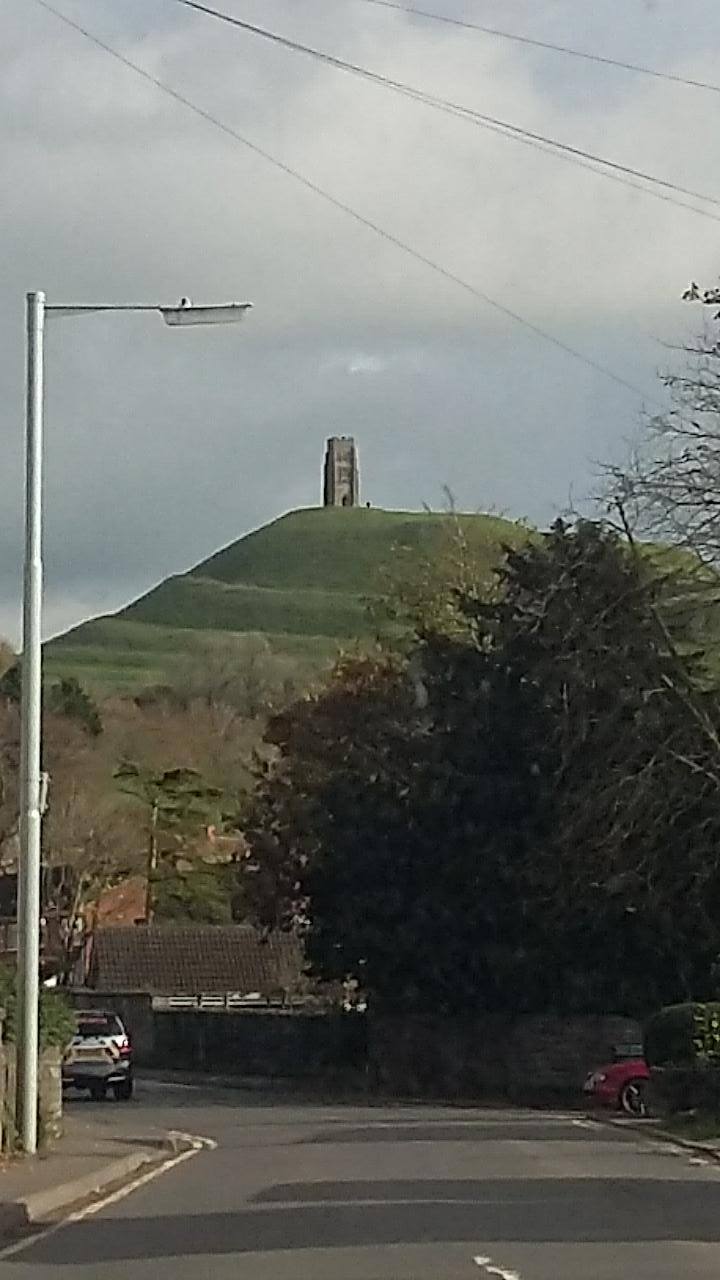
  And what has any of this to do with observing the ancient feast of Samhain in Somerset? Very little but contrivance, really; the legend of the dragons is a small part of the 'Matter Of Britain', that tangled corpus of mythology with a strong Arthurian bias, and Somerset contains many sites that are connected with the Once And Future King. Sites such as Cadbury Castle, the hillfort that the locals once claimed as Camelot, the hillfort Brent Knoll where Arthur fought a giant, and the town of Glastonbury which has been associated with the mystical Isle Of Avalon since the 12th century. In British mythology, Glastonbury Tor is said to be the entrance to the faerie realm of Annwn, presided over by the Winter King, Gwyn Ap Nudd. These discrete elements came together this last Samhain/Hallowe'en to provide a procession and celebration at Glastonbury, an event which also drew inspiration from a more international tradition, that of the Wild Hunt, of which more later.

Glastonbury Tor

The Market Cross

The Samhain 2017 Wild Hunt has been organised by a community group called the Glastonbury Dragons, whose aim is to hold events like this twice a year, the other significant date being Beltane/ May Day ( which we habitually celebrate in a field in Hampshire with a large Wicker Man). Through the use of local and social media, they have cordially invited anyone with an interest to gather at the town's Market Cross for 3pm on Saturday 4th November. The Cross itself is a Grade II listed structure, built by a Benjamin Ferrey in 1846. Constructed with ashlar masonry to a Perpendicular design, it certainly reflects the Victorian zeal for the neo-Gothic.

Market Cross, in sunlight and shadow.


Eldest and I are representing Team Vulpine at this event, and when we arrive at the Market Cross we see that the assemblage is gradually swelling with newcomers, with still an hour to go before the procession begins. A nearby café, the 'Lazy Gecko', offers warmth and hospitality, and we step inside to nourish ourselves before the main event. I order the Gecko Special.

Two poached eggs, smoked salmon, Portobello mushrooms, spinach, sauté potatoes and granary toast. Eldest had a Panini. As I remarked, "We wouldn't want to open the gates to Annwn on an empty stomach."

The Wild Hunt gathers at the Cross

Samhain shenanigans


  We rejoin the gathering. Many have arrived in vibrant and elaborate costumes, ranging from the gruesomely garish to the colourfully comical. My personal favourite was the Centurion who, in a masterpiece of improvisation, used a paintbrush as a crest for his helmet.

'At my signal, unleash hell'

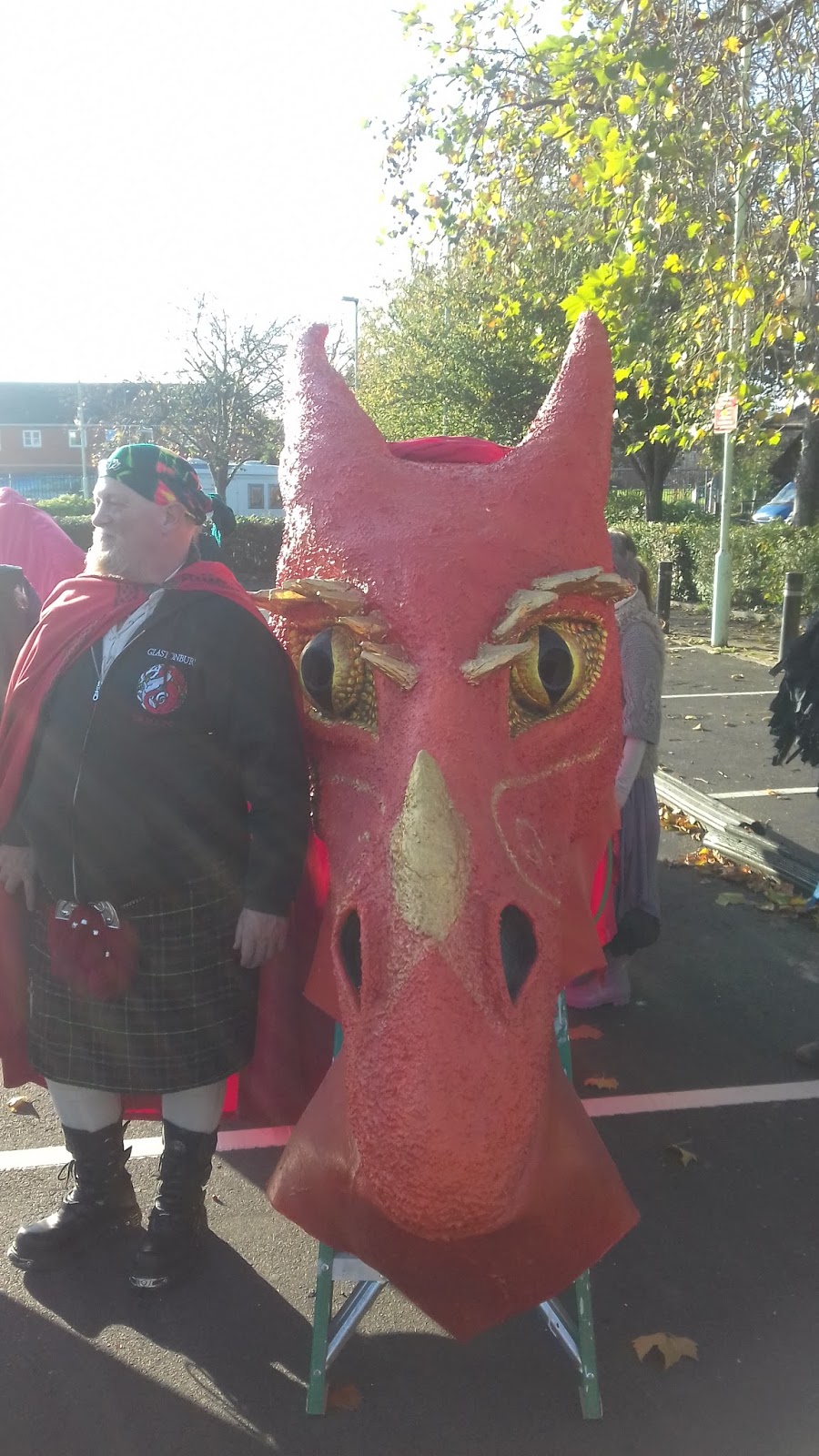
The town's Mayor and his Deputy turn up to give a welcoming speech. The throne of Gwyn Ap Nudd is placed in position, and a call goes up for volunteers to assist in 'motivating' the two dragons, currently languishing in a car park around the corner. We came to the town to witness a Samhain event, hopefully one that will prove as memorable as Samhain events we have attended elsewhere... and now we find ourselves persuaded to actively take part in the parade itself. Just call us 'dragonriders', please. It's a cool word to add to the CV.

Red Dragon

White Dragon

In the belly of the White Dragon


  We crawl into the White Dragon. I take up position as its 'shoulders' while Eldest supports the 'tail', and we shuffle forward, side by side with our crimson counterpart, to join the gathering at the Market Cross. 'Gwyn Ap Nudd' has taken position on his 'throne', and he is borne aloft, and, with a Crier in front of us to clear the way, we embark on our Wild Hunt.

'Go away! I'm not talking to you'
The Wild Hunt

The story of the Wild Hunt can be found, in various incarnations, throughout Europe. At its core is a group of hunters in pursuit, but these hunters do not have to be human - they can be faerie folk, gods, even ghosts. Depending on custom, the leader of the Hunt can be chosen from a wide range of characters, both historic and mythical. He can be Woden, Herne the Hunter, Theodoric the Great, or biblical figures such as Herod, Cain or the Devil.

  The Glastonbury Dragons have chosed Gwyn Ap Nudd to preside over their Wild Hunt. In Welsh/Brittonic mythology, Gwyn is the King of the Tylwyth Teg, the 'fair folk', and rules over the Celtic Otherworld, Annwn, the entrance to which lies at Glastonbury Tor. He, along with various other members of the Ap Nudd family, appear on many occasions in medieval Welsh literature. His earliest appearance appears to be in the Arthurian story Culhwch ac Olwen, one of the tales that was included in the Mabinogion when it was compiled by Lady Charlotte Guest in the 19th century. The structure of this story suggests that it was originally intended to be orally transmitted by bards, so it may date from as early as the sixth century.

Gathering at the Fair Field


  In Culhwch ac Olwen, Gwyn steals his sister Creiddylad from her husband-to-be, Gwythyr ap Greidawl. The dispute comes to the attention of King Arthur, who gives the order that Gwyn and Gwythyr must do battle every May Day until Judgment Day, when the victor of  that final battle would finally be able to claim her. The story also states that Gwyn was 'placed over the brood of devils in Annwn, lest they should destroy the present race'. It is believed that this represents a contest between the seasons, with Gwyn as the Winter King and Gwythyr as his Summer counterpart... and what better way to mark Samhain, the feast at which Summer gives way to Winter, than to re-enact this symbolic strife at the legendary entrance to Annwn itself?

  It is amusing that we have come a hundred and eighty miles to witness a procession, only to participate in such a way that we cannot see any of it. Shrouded in white canvas, in a line with my son and a handful of other volunteers, I can only see the tarmac beneath my feet and I have to rely mostly upon what my ears are telling me. Drums resonate and horns shriek in the bustling streets of Glastonbury, the mystical 'Ynys Witrin'. The rumble of chattering crowds and growling traffic competes with the carnival melodies, and our guide clears our path with cries of 'Make way for the Dragons!'

Followers of the Red Dragon


 Two sinuous leviathans with the occupied throne of Gwyn Ap Nudd borne aloft behind us, we swerve into a side-street and skirt the walls of  town's venerable Abbey ruins before proceeding uphill towards the Tor. Another turn to the left, and I call a warning to my fellow Dragonriders as we cross a cattle grid, and the tinkle of running water tells me that we are processing between the two famous Springs, the Red and the White, their famous waters reflecting the shades of our Draconian disguises.

  Legends are drawing together. The Wild Hunt, the symbolic skirmish of the seasons, the mythical origin of the world-renowned Springs, all combining for a celebration the origins of which are lost in time. Past the Springs, along the lane, then into a field on the lower slopes of the Tor, the Fair Field where the folk of Glastonbury would gather for revelry in medieval times, now bearing witness to a different kind of gathering. Here, we cast off the canvas, gently settle the dragons onto the lush Autumnal grass, and gather around a cordoned area further into the meadow. The wonderful views add to the grandeur of the Samhain atmosphere. The hulk of the Tor rises directly to our east, some of its continuous flow of pilgrims halting to watch our proceedings. To our west, beyond the smaller bulk of Chalice Hill, we see as far as the Bristol Channel, the Quantock Hills, Exmoor, bathed in a seasonal haze, tinted a warm orange by the descending sun. The outline of the Holy Thorn can be picked out a mile away, on the hogsback called Wearyall Hill, another Glastonbury legend, watching us from a discreet distance.

The throne of Gwyn Ap Nudd


The revels continue. Morris dancers strut their stuff, rituals are enacted, a symbolic fire is lit by two girls, dressed in red and white to represent the dragons. Another blazing brand is added by Gwythyr and, wielding a flaming sword, by Gwyn. With the climbing of the flames, my son and I take our leave and descend from the Fair Field.

  Dusk gathers, and with it come rainclouds from the west. The Tor soars sharply above the fecund sedge moors. Below the dual springheads, the colours swirl to one. On Wearyall Hill, the Holy Thorn leans into the wind. The Abbey stands derelict, its glories faded past... and smoke from the Samhain bonfire swells into the crepuscular sky as the veil between the Worlds grows porous, and the ancient British myth of Annwn stirs from its dormancy, in the midst of a land of legend...


Samhain fires burning

Gwyn Ap Nudd


Previous Samhain-flavoured articles:

Samhain In Ytene

Samhain In Southwark

Season Of The Witch